Our Lady of Guadalupe Rosary Sign-Up

A series of Rosaries prayed in honor of Our Lady of Guadalupe will begin on September 15 th until the feast of Our Lady of Guadalupe on December 12th. If you are interested in hosting, please contact Mrs. Enriqueta or the office for more information.
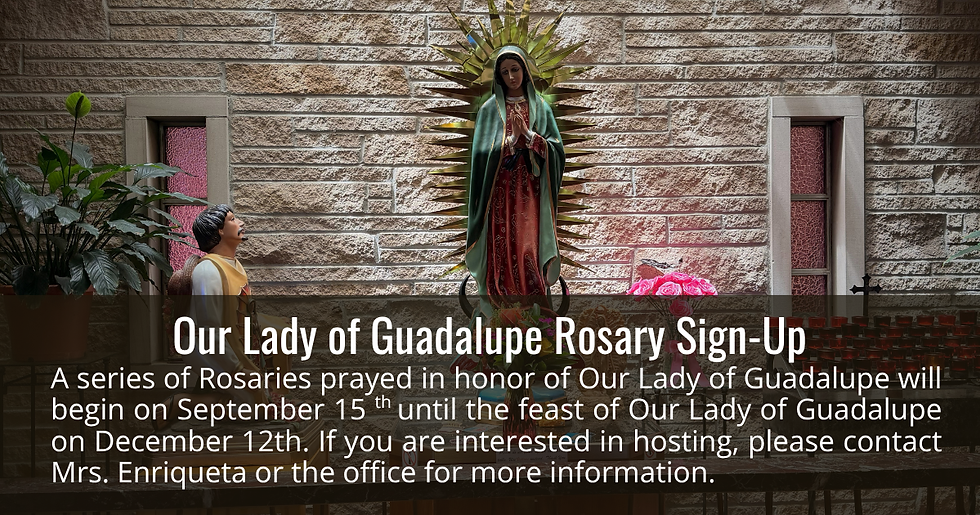
You may be familiar with Our Lady of Guadalupe from devotions in Hispanic communities. There is a rich heritage originating in Mexico, the site of the apparition of Our Lady of Guadalupe. But Mary is for all of us! Our Lady of Guadalupe is, in fact, named the patroness of all the Americas, from the Chilean Patagonian mountains to the Arctic islands of Canada.
After Mary appeared to St. Juan Diego as a young, mestizo woman, conversions to Catholicism began to grow exponentially throughout Latin America. Our Lady of Guadalupe has been meaningful to the Mexican people, and her image and devotions have been incorporated as broader symbols of culture.
This apparition inspires across lines of nationality and culture. Juan Diego, recipient of the apparition, was a poor laborer. The famous image of Our Lady of Guadalupe did not appear on silk or stone, but on the simple, natural woven fibers of Juan Diego’s tunic. The apparition affirms the dignity of the poor and shows striking solidarity. Mary appeared as the people appeared. In the apparition, Mary is indeed radiant, with the sun behind her and a cloak of stars around her. But her dress is simple, and she is pregnant. This apparition also reminds us of the sanctity of life and the need for life’s protection at all stages. Mary’s moving words to Juan Diego are words for us all: “Am I not here who am your mother? Are you not under my shadow and protection? Are you not in the folds of my mantle, in the crossing of my arms?”
Question:
Why does Mary have so many feast days and names?
Answer:
Christians first began celebrating feast days in honor of Mary, the Mother of Jesus, in the fifth century. That celebration (originally called the Feast of the Dormition and now known by Roman Catholics as the Solemnity of the Assumption) was celebrated on August 15. Very soon, however, other special days dedicated to Mary began to appear in Jerusalem, Rome, and other major cities of the Christian world. These days of feasting became important parts of the life of the community. But, more importantly, each of these unique celebrations became an opportunity to focus on a different facet of the Christian faith, as believers focused their attention on specific events or mysteries of the lives of Mary and her Son.
Over the centuries, some of these celebrations became universal (such as the Assumption on August 15, the Immaculate Conception on December 8, and the Solemnity of Mary, Mother of God on January 1). Other celebrations were more closely tied to certain religious orders (such as the Carmelites celebration of “Our Lady of Mount Carmel” on July 16 or the Servite Friars feast of the “Seven Sorrows of Mary,” which is now celebrated as the Memorial of Our Lady of Sorrows on September 15).
In more recent times, Marian apparitions (like Guadalupe, Lourdes, and Fatima) have inspired special liturgical celebrations. Pope Francis has added two new celebrations of Mary to the Church’s calendar: The Memorial of Mary, Mother of the Church (on the Monday after Pentecost) and the Commemoration of Our Lady of Loreto (on December 10). The various titles of Mary (like those we find in the Litany of the Blessed Virgin Mary) help us to reflect on different aspects of Mary’s faith and the ways that the Holy Spirit is at work in her and through her, especially as the Mother of Jesus.
In the end, whatever the event or mystery being celebrated in a particular liturgy or the title of Mary being used, we are invited to always see Mary in connection with the saving work of her Son. She is, of course, a patroness and protector for every Christian, but she is also a model of discipleship and contemplation: “Having entered deeply into the history of salvation, Mary, in a way, unites in her person and re-echoes the most important doctrines of the faith: and when she is the subject of preaching and worship she prompts the faithful to come to her Son, to his sacrifice and to the love of the Father” (Lumen Gentium, 65).
Text used with permission from Lpi.


Comments